Showing posts with label What on the earth are Chinese doing/thinking?. Show all posts

11/24/2009

Chinese Zodiac 豬zhü (pig) -- The Oink, The Merrier


豬zhü


pig (1909, 1921, 1933, 1945, 1957, 1969, 1981, 1993, 2005)
Simplified character: 猪


Pig is a domestic animal, mostly for the purpose oral consumption. In the old days, due to the farm house environment, pig was perceived as dirty and lazy - hence deserved the fate of being consumed. However, the more recent studies showed that pigs actually prefer clean environment, like to walk around, and is mostly energetic - environment permits.


Also, a boar (wild pig) is nowhere near domestic. A boar has fangs and is likely much more dangerous than a tiger in the jungle. A herd of boars travel in pack, guiding by a leader that walks in front. The leader raises its tail to indicate its social ranking and to declare leadership.


Pig people are also very energetic, warm and easy to get along with. Once becoming a good friend, pig people would be a friend of a lifetime. They would take great care of their friends and families, with much generosity and love. Pig people have a passion for knowledge, mostly honest unless circumstances beyond their control, and have great endurance.


However, as the boar is considered dangerous, pig people also have their dark sides. They are individualists and temperament; they lack communication skill and are highly jealous. As the leader boar raises its tail to declare leadership, when pig people are leaders of groups, they also like to display and secure their leadership. They do no like to be challenged and thus tend to have a strong tendency to force their teammates (or subordinates as the pig people see them) to do as they command. Since a boar when irritates would attack whatever is on its way, so would a pig person that sets out for destruction when loose control. They would do whatever it takes until the targets are destroyed. Unfortunately, along with way, they may cause their own demise.


--Click here for more ab Chinese Zodiac : )


The source of the picture is from: http://marie0925.deviantart.com/art/pig-48989903

11/05/2009

Something to wash the food down - besides the pint and the coke…ok, and Pepsi

We pretty much chow down three types of food last time, I am sure everybody must be feeling a bit tingling along the pipe.  With food all around you, do you think the drinks would be too far away?  But seriously, if you want beer, go to a pub.  If you want coke (and/or Pepsi), there are 7-11s.  When you come to shì, why settle for the frequently-stored-in-the-freezers?


Let see what you can play with.  Be experimental, be ignorant, be brave!!


gǔobïng (NT$40~45/plate, choice of 4 toppings, and additional NT$10 with condensed milk) is, likezhüxěigaü, my favorite under the 'ice' category.  It is like Hagan Daz with choice of nuts or sprigles, gǔobïng is made of chopped ice topped with four dressings of your delight.  Likeyíen, you can see everything in front of you for you to choose.  My combination mostly consisted of Chinese mesona jelly (xïancăo), lotus seed (liánzĭ), white fungus (báiĕr), and green beans (绿dòu).  Of course you can also choose from red beans, strawberry jam, sliced salted carambola (star fruit), sweet yam mixed tapioca (five types of those: big, small, assorted color, purple, etc.; I really couldn't quite tell the difference).  The lady of the stand after adding the toppings into the container/plate, turns on the ice grinder and fills the container/plate with ice and then pure a scoop of sugar water on top.  When you eat, remember to mix everything with the ice and sugar water.  The thought of this really makes my mouth water.  Think I'll help my self with one after I am done.


There is a type of juice stand, which is not really a juice stand.  We'll call it yángtáobïng (ice carambola / star fruit juice) or süanméitäng (ice prune juice) (NT$25~35/cup, based on cup size).  The stand normally uses huge transparent cylinders to hold the juice.  Some stands offer three types of juice, some may offer more than five.  Besides the mentioned two most common juice selections, there may also be dönggüachá (a type of squash, sweetened and boiled into juice, not really a tea as the name suggests), gänzhèzhï (ice sugar cane juice), and qïngcăochá (a type of bitter herb).  These types of juice serve more than just thirst quenching.  Most of these drinks actually, by Chinese herbology, carry the effect of reducing the heat in the inner organs caused by consuming food - especially fried food.  They also help with bowl movements (note: note cure, just help).  Wonderful, isn't it??  We put the poison right next to the cure (or the cure right next to the poison?)!!  Idea courtesy of her Mother Nature.


Not exciting enough?  Here comes something that might gross you with the name and with the name only.  It's called qïngxìadàn (NT$50/cup) - eggs laid by frogs. You must be "O.M.G" out there in unification.  Relax, it's just a nickname for the toppings in the drink.  It's, again, another type of tapioca.  Originally it's from boat sterculia seed, which has a transparent to milky white gel like surface with a black seed in the middle, looks like the eggs of the frogs, hence the nameqïngxìadàn. Just like other juice, this also carries the detox and heat reducing effect.  However, since boat sterculia seed is actually not that easy and common to acquire, it is replaced by tapioca.  The taste of this drink actually comes from honey and sugar.  Either tapioca or boat sterculia seed does not have a distinct flavor of its own.


And derived or evolved fromqïngxìadàn, comes the now worldwide phenomenon zhënzhünăichá (NT$25~35/cup, hot or ice, small or big)- the pearl tapioca milk tea!!  Ok, when I said 'worldwide phenomenon', I may have exaggerated a little bit (treat you to a cup if you know where I imitate this phrase from); although I do know besides the usual Chinese societies in the Asia, franchise of this type of drinks can also be seen in California, New York where the Taiwanese communities are.  When we conquer, we don't stick a flag to declare ownership, we wheel our favorite food stand in.  Now that's what I call a true conquer.  But enough of that.  The drink stands or small shops used to sell milk tea (yes, tea).  Whenzhënzhünăichá swept the country from the south, one had to make a special request for the tapioca NOT to be added into the drink.  Owing to my lactose intolerance, I normally request for the milk to not be added, and a choice of either black or green tea with the tapioca.  Again, the tapioca basically has no distinctive taste.  Even so, if it is not properly, you'd feel like chewing down a robber bullet.  A properly prepared tapioca will be chew and soft.  The taste of the drink mostly comes from the tea, so the tea is also a key element whether the money is well spent.


Ok, we did good today!!  Let's take a break and be back for the last three.


I am getting my self agǔobïng now.


find out more interesting part of Chinese culture

10/27/2009

"Small" in serving portion and price, "huge" in sentiment value - 小xĭao吃chï

Eating is actually very important to us Chinese.  After all, what can you really do when your stomach (brain) is sending out all sorts of signal around your body, crying "food, food" or "please sir, may I have some more?"


We call the food that is not part of an official meal as xĭaochï, xĭao meaning small, chï is to eat.  Some small things to eat.  This is different from snacks, such as potato chips or beef jerky.  xĭaochï can also serve as dishes in a meal.   It ranges from sweets to a bowl of soup, as what we talk about in the topic of yèishì, the night markets.

The reason why I bring this up is because lately I have more chances to usexĭaochï in replacing a meal.  Living close to one of the prestige night markets is actually quite a blessing when "what to eat for lunch/dinner" question become a conundrum for only three members in a family.  It is even more helpful for people who live by themselves or are too busy to sit down for a meal. 


Sometimes I thinkxĭaochï represents a sad reality when people no longer bound as a family and share their love for each other over the dinning table.  But at times I also think that, if the love for each other can only be shared on the dinning table, it would, if not more, also be a sad thing.  

Perhaps now we leave the cooking to others, and simply share food with each other through these small dishes, and grasping every valuable second that we share together.

So close yet so far away…….


You may also want to find out what on the earth on Chinese people are thinking!

10/23/2009

Eating! Although some sound disgusting…

The fun ofshì is that the food is not expensive, there is no formality, you meet fun local people, and get to test your threshold on the innovative/experimental food.  Well, to us Chinese, the food is about putting edible material together and creates new sensation or an entire new food group.  For me, it's just about eat and walking at the same time without causing the "shi" and "boo".  And it's like breakfast - full of infinite possibilities.

So here is my own person top 10, and the average selling price in its local currency.


My all time favorite is zhūxiěgāo (NT$25/piece)the pig (zhū) blood (xiě) cake (gāo). Yes, it sounds gross and I sound like one of those HBO True Blood biters, but I grew up with this and I missed it whenever I could not have it for a long time. The gross part is that, I am really sorry to say this, the blood part is true.  This snack originally is made mixed with chicken blood, but the use of blood depends on which type of animal blood is easier to acquire.  It is more common now by using pig's blood.  It's not kosher, but I am not a Jew (ok, I know this is just a lame excuse).

This rectangular piece of thick black block is normally served on a stick.  The seller takes it out of the bamboo steamer, soak it in soy sauce which is normally house blended to give special flavor, and then soak in hot sauce if spicy taste is preferred.  After that, the cake will be blanketed with peanut powder, and dabbed with coriander.  The taste, well, personally I prefer a firmer texture as I like to chew on things (no erotic implication here).  The cake is made of sticky rice, so the taste and texture mainly come from the rice. It also has gentle sweetness from the peanut power, which is mixed with the scent of the coriander.  Except for the name, the blood part is really undetectable at all.  Over the 4 decades of my life, I have tasted good and bad and the really good and bad ones but I've never tasted blood in this food.  To a point I think the blood part is a nickname for the black appearance.  Again, I am very sorry to say this, it IS indeed from the blood.  I think I can skip the part on how to eat this, as it is no more than an open wide and bite.  Oh dear, did I just say that?


xiāngcháng (NT$35/pc, 3 for NT$100) would be my next choice, although this one sometimes rises to the top.  xiāng (scented, smell good) cháng (intestine) is, fortunately, not made of any scented intestine of any animal .  This name is purely a description of the appearance and the flavor.  It is the official name for sausage.  yes, sausage.  The make and the look is no more than the regular sausage, so why is it so special and a must try?  As I said, food to Chinese is about putting edible material together and creates a new sensation, so the special part is how they prepare the sausage and what you can have inside the opened up sausage.  The sausage stand roasts the sausage on an open fire and is also served on a stick.  My personal favorite is the original, pure sausage with no extra.  There is a particular stand that I go to (and go to only, caused I tried others), their blend of sausage tastes juicy and rich, with the firmness that I like.  But for the variety that makes this sausage different, there are fillings that can be chose from: black pepper, lemon juice, chopped garlic, chopped coriander, chocolate, red onion, etc.  And if the sausage is not big enough a portion, the stand also has can wrap the sausage in another larger sticky rice sausage, which is called (big) cháng (intestine) bāo (to wrap) shǎo (small) cháng (intestine), in which the larger sticky rice sausage is the "big intestine" and the regular size sausage the "small intestine".  This one normally is at NT$45 a piece.


yán (NT$30 per serving, around 100g) is more than just crispy fried small pieces of chicken with salty flavor as the name suggests.  yán means salt, is one of the descriptions for crispy and crunchy, and is the chicken here.  This name originally is for chicken only, but as the category expends (we are fun loving people, remember?), this name of the 'cousin' now stands for a lot more than chicken.  The key is to deep-fry everything and sprinkle with a lot of those salty mixed pepper.  The things you can choose from are all displayed before the boiling pot of oil.  There are pig blood cakes, long string beans, green pepper, types of mushroom, chicken steak, hot dog, fish, different types of tofu, hash brown (the potato 'cake'), taro sandwich (two slices of Ritz cookies with mashed taro in the middle), chicken's 'tusshies' (tukers', behinds; basically the parts where the chickens sit on - among other functions) on the stick, grounded fish cake, etcetera, etcetera, etcetera.  I think the stand itself already defines "the infinite and beyond".  I normally spend over NT$100 on the stand, and the portion pretty much gets me stuffed for the whole night.  If you bring the food home, besides the usual Coca Cola (ok, and Pepsi if you must), the best drink to wash the food down would be beer.  Button's up!!

Ok, three down, seven more to go.  I promised the rest would be faster.  So see you next time.


You may also want to read the introduction of Chinese night market culture

10/20/2009

Put your wind and your water where they should be --with a little bit of 风fēng水shŭi


My brother has just purchased his own house. Since my sister-in-law is a student of the art of fortune telling, she invites her teacher for advices on some details for the hanging places of paintings and ornaments, as well as what types of ornaments to be acquired.


Although we are actually a Roman Catholic family, everyone cannot help but eavesdropping on the details and perhaps making our own notes on the do-s and don't-s. 


fēngshŭi is actually part of our daily practices. We more or less would put it into consideration whenever we have a new living or working space.  It is not entirely out of superstition; it is more of "since I know this, might as well follow it" mentality.  Hint or suggestion has a much profound influence than it appears to be.  As long as we receive the hint or suggestion, it would be very difficult to not associate it with the consequences.  After all, prevention is indeed better than cure.


So what isfēngshŭi exactly?
The Chinese characterfēng means the "wind"; and shŭi means the "water".  Wind of course refers to the air flow or air circulation; naturally water implies the humidity.  In many centuries ago, careful observers the well learned ancient Chinese environmentalists noticed the importance of proper airflow and humidity in the living environment would affect greatly the residents in the house.  People who lived in a house with proper air circulation and humidity tended to have better health, spirit, and most of all, wealth.  Logically speaking, when a person is healthy, he/she tends to think positive thoughts, which lead to higher spirit; and with positive thinking and optimistic attitude towards life, the person is easier to achieve the goals in life - be it wealth or others.


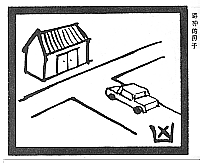
But fēngshŭi is more than just a practice of the early LOHAS living style.  It also combines the housing interior hygiene and safety, as well as the community planning.  My favorite example would bechòng, so let me use it to illustrate this claim.
chòng is the conflict with the road(s).  A house at the end of a road, or a house at the junction of the roads, is unlikely to be on top of the 'must buy' list; especially the ones with its front door opening to 'greet' the roads.  A fēngshŭi master will explain that because a house sits on that kind of location receivesshàchì, the bad vibes, directly from the road(s).  Any family that lives in a house like that would not only have bad fortune, but that members of the family may die from accidents or other unnatural causes.  From a modern community-housing planner's point of view, the statistics do show that houses situated at the end of a straight road have higher accident rates. Reasons being that, especially when the road is wide and the traffic is busy, a driver, when speeding, may not have sufficient response time to turn the car to the right or left, and often runs straight into the house at the end of the road.  This is even true in the old days when horses were the 'car wheels'.  So bad vibe or not, when the accident did/does happen, family members did/do die from accidents and/or other unnatural causes.


There are more examples in thefēngshŭi taboos that actually have their scientific explanations, and that the superstition sometimes is just a unspoken law/regulation established for the commoners to abide in avoiding dangers.  Next time when I encounter another one, I will bring it up again and share with you. 

 I promise.


10/16/2009

Feast of the Night - No Shoes or Ties Required


shì, the night market, is perhaps the most famous food places for the tourists that visit Taiwan. means 'night' and shì means 'market', so naturally the term refers to the markets at night time.

As I researched for this article, to my surprise (even), I learned that night market actually could be dated back to Táng DynastyJune 18, 618~June 4, 907.  What do you know? We are indeed a people with a long long history!!  In Tang Dynasty, night markets only existed in big cities such as the capital city chángānchéng. There was once a ban lifted against night markets due to the noise it stirred up.  The night market was officially approved and widely set up in Sòng Dynasty (960~1279, pity that I cannot also include the dates, it would have been smashing if I could). Since then night markets have became part of the daily lives of the Chinese (see, we are really not a serious people, we do know our food folks and fun!!  A few more rounds for this table here!).

Night markets started out with one to more food stands at the corners of the busy streets. When the food stands began to attract crowds, the cluster of food stands evolved into a larger scale market. And since nighttime tends to attract more crowds, the market opens around the end of office hours until early morning, around 2 or 3 am.  After that, the regular market will take place to continue the day.


My neighborhood is blessed with one of the older night markets in Taiwan.  I myself witnessed its prime time. The night market near my neighborhood is línjiāngshì, also know by its older name tönghùashì The name of the night market usually is derived from the streets it locates. línjiāngshì is on línjiāngJië, which is a cross street on tönghùaJië, but becausetönghùaJië is much more famous and is a major street, people used to refer to the night market astönghùashì. As night markets get their markings on the tourism maps, this neighborhood actually went through a debate on the name of the night market. Eventually, probably has some conspiracy or glooming political agenda behind, the night market's name was reverted back to the correct street it's on.


Within a five minutes walk, there are over 100 food stands that provide different types of food flavor, some are local cousins, some exotic. These food stands are not restaurants, so they only need a few foldable tables and stools for the eaters to stay for a short period of time before moving on to the next stand. There are no silver utensils or white linen tablecloth, not even tentative smiling waiter or waitresses.  You'll probably bring your own napkin or even moist towels - with the rising the global environmental protection consciousness, you may even need to bring your own chopsticks or spoons. But what the heck, the food is good, and the food is much more affordable, so who cares if you need to bring your own stool or foldable plank for table?


So how good is the food? Well. Why don't I come back with that information next time?  Let me first brush up on my food list a bit (and perhaps put on a few more pounds) and come back with my own top 10 list for your taste.

Be back soon.

(photos from google.co) 


you may also like these free writings about Chinese culture